Saturday, 16 November 2013

Friday, 11 October 2013
Assignment 2: The Brief
- Master bedroom (with walk in robe and ensuite)
Walk in robe - minimum 8 lineal meters of hanging.
Ensuite - bath and shower in one, toilet.
Minimum two otherOne general bedrooms
- Bathroom associated with
these twothis bedrooms-
- Study / library
- Guest bedroom
Will be fairly small as it will not be used too often.
- Studio / workshop
Will be 'hub of the house'.
- Formal living room
- Formal dining room
Informal family area
Kids play room
- WC
- Kitchen
- Laundry
- 2 car garage
Relationships:
- Bedrooms should be grouped together, the guest bedroom would be located near the public area.
- Studio ('hub of the house') would be located near the public areas - kitchen, living room.
- Walk in robe should be used as a buffer between the bedroom and ensuite. Can also be used as an entrance into bedroom suite, but then must have doors on robes to make it look better
- Garage to have internal access from house, from the studio in particular to allow for convenience and ease for Piranesi to transport his work from his studio to the storage space in the garage. Also from a more public space - kitchen or living room.
Design notes:
- Design and furnishing would be inspired by Ancient Etruscan, Greek, Roman, and Rococo style.
- Over the top design.
- Large windows for natural lighting
- High ceilings within the house - will have two stories to include the use of stairs as is reflected in his work - the Drawbridge.
- Stairs will have to be wide
- Entrances - large archway entrances to different rooms - generally reflected in his work also.
Thursday, 10 October 2013
Assignment 2: Site Analysis
Site analysis


Site area: 713sqm.
Existing sites according to site survey above:
Lot 3 -Two storey rendered brick residence.
Lot 5 - Two storey rendered brick residence.
Land Zone
R2:
Low density residential (LEP, p11-12)
Objectives
of zone
-
to provide for the housing needs of the community whitin a low density
residential environment
-
to enable other land uses that provide facilities or services to meet the day
to day needs of residents
-
to retain the single dwelling of character of the environmentally sensitive
residential areas of Mosman.
-
To maintain the general dominance of landscape ove build form, particularly on
harbour foreshores.
-
To ensure that sites are of sufficient size to provide for buildings, vehicular
and pedestrian access, landscaping and retention of natural topographical
features.
- To ensure that development is of a height and
scale that complements the desire future character.
-
To encourage residential development that has regard to local amenity and, in
particular, public and private views.
Distances to transport and local services

Bus stop ~65m.
· Balmoral beach ~100m.
· Balmoral Beach Club ~150m.
· Awaba Café ~250m.
· The Bathers’ Pavilion ~300m.
· Hunters Park ~500m.
· Rocky Point ~550m.
Meaning
|
Description
|
Numerical
results
|
Reference
|
|
Maximum
height
|
 |
Maximum
of two storeys. Council may allow an additional storey in attic roof space of
existing and new buildings, or in the foundation space of existing buildings,
provided that the building height and bulk is of an appropriate form and
scale.
Council
may consider consistent pitched roof forms to extend beyond max building
height.
|
Max
height = 8.5m
Max
wall height = 7.2m.
|
Clause
4.2, Siting and Scale (RDCP)
|
Floor
space ratio
|
The
floor space ratio of buildings on a site is the ratio of the gross floor area
of all buildings within the site to the site area.
|
Maximum floor space ratio if the site
area is greater than 700 square metres—0.5:1 for
700 square metres and 0.4:1 for the
remaining area.
|
Site
area = 713sqm
FSR
= (700x0.5) + (13x0.4) = 355.2sqm.
|
Clause
4.4A, Floor Space Ratio – Area 1 (LEP)
|
Setbacks
to boundaries
|
Setbacks
define the overall footprint of a building and the outer extremities of that
building in relation to the front, side and rear boundaries.
Appropriate
street setbacks controls can contribute to the public domain by enhancing the
streetscape character and continuity of street facades.
|
 |
Minimum
side boundary setback of:
900mm
if single storey (<3.6m wall height) or
1.5m
if two storey (up to 7.2m wall height)
|
Clause
4.2, Siting and Scaling (RDCP)
|
Fencing
|
Fences
play a major role in deteminnig the appearance of developments and their
contribution towards the streetscape.
|
Front
fences, and side fences forward of the building line, must have max height of
1.2m above footpath level.
|
Max
height of 1.2m, under special circumstances may exceed up to 1.8m.
|
Clause
5.2, Fences and Walls (RDCP)
|
Landscaping
|
Landscaping
plays an important role in integrating new development into a streetscape, improving
the level of amenity, improving local habitat for flora and fauna.
|
For
site areas between 500-900sqm, the following formula must be applied (resulting
in a percentage of site area).
LA%
= 30+[(SA-500)]/20
Where
SA = site area = 713sqm.
|
LA
= 30+[(713-500)/20]
Minimum
landscaped area as percentage of the site = LA = 40.65%
|
Clause
4.4 Landscaping (RDCP)
|
Notes:
View sharing
(Clause 4.3, View Sharing (RDCP))
- - Public views and vistas must
be protected and maintained where possible – where available from the street,
should be preserved by use of open style fencing and carports.
- - New development should be
designed to minimise view loss to adjoining and adjacent properties while still
providing opportunities for views from the development itself.
- - Trees with light open foliage
and canopy are preferred (which do not obstruct views but do contribute to the
wooded landscape of Mosman. Species such as Leyland Cypress (Leighton Green)
and its cultivars should not be planted)
Friday, 13 September 2013
Week 7: Brief Exercise
RESEARCH:
Piranesi was born in Mogliano Veneto, near Treviso, then part of the Republic of Venice. His brother Andrea introduced him to Latin and the ancient civilization, and later he studied as an architect under his uncle, Matteo Lucchesi, who was Magistrato delle Acque, a Venetian engineer who specialized in excavation.
One of the greatest printmakers of the eighteenth century, Piranesi always considered himself an architect. The son of a stonemason and master builder, he received practical training in structural and hydraulic engineering from a maternal uncle who was employed by the Venetian waterworks, while his brother, a Carthusian monk, fired the aspiring architect with enthusiasm for the history and achievements of the ancient Romans. Piranesi also received a thorough background in perspective construction and stage design. Although he had limited success in attracting architectural commissions, this diverse training served him well in the profession that would establish his fame.
he apprenticed himself briefly to Giuseppe Vasi, the foremost producer of the etched views of Rome that supplied pilgrims, scholars, artists, and tourists with a lasting souvenir of their visit. Quickly mastering the medium of etching, Piranesi found in it an outlet for all his interests, from designing fantastic complexes of buildings that could exist only in dreams (37.45.3.41), to reconstructing in painstaking detail the aqueduct system of the ancient Romans.
The knowledge of ancient building methods demonstrated by Piranesi's archaeological prints allowed him to make a name for himself as an antiquarian.
working in the studio of Giovanni Battista Tiepolo. From this period date Piranesi's etchings called grotesques: rococo shapes interlaced with fragments of ancient ruins.
In his preface to the Diverse maniere d'adornare i cammini of 1769, which includes both of these etched plates along with designs in the Etruscan, Greek, Roman, and even Rococo styles, Piranesi argued for the complete freedom of the architect or designer to draw on models from every time and place as an inspiration for his own inventions.
Piranesi was born in Mogliano Veneto, near Treviso, then part of the Republic of Venice. His brother Andrea introduced him to Latin and the ancient civilization, and later he studied as an architect under his uncle, Matteo Lucchesi, who was Magistrato delle Acque, a Venetian engineer who specialized in excavation.
One of the greatest printmakers of the eighteenth century, Piranesi always considered himself an architect. The son of a stonemason and master builder, he received practical training in structural and hydraulic engineering from a maternal uncle who was employed by the Venetian waterworks, while his brother, a Carthusian monk, fired the aspiring architect with enthusiasm for the history and achievements of the ancient Romans. Piranesi also received a thorough background in perspective construction and stage design. Although he had limited success in attracting architectural commissions, this diverse training served him well in the profession that would establish his fame.
he apprenticed himself briefly to Giuseppe Vasi, the foremost producer of the etched views of Rome that supplied pilgrims, scholars, artists, and tourists with a lasting souvenir of their visit. Quickly mastering the medium of etching, Piranesi found in it an outlet for all his interests, from designing fantastic complexes of buildings that could exist only in dreams (37.45.3.41), to reconstructing in painstaking detail the aqueduct system of the ancient Romans.
The knowledge of ancient building methods demonstrated by Piranesi's archaeological prints allowed him to make a name for himself as an antiquarian.
working in the studio of Giovanni Battista Tiepolo. From this period date Piranesi's etchings called grotesques: rococo shapes interlaced with fragments of ancient ruins.
In his preface to the Diverse maniere d'adornare i cammini of 1769, which includes both of these etched plates along with designs in the Etruscan, Greek, Roman, and even Rococo styles, Piranesi argued for the complete freedom of the architect or designer to draw on models from every time and place as an inspiration for his own inventions.
BRIEF:
Inspired by Ancient Etruscan, Greek, Roman, and Rococo style.
- Bachelor pad
Piranesi had no partner or kids, so he will most likely be living alone.
- Grand, spacious, with a high ceiling for the rooms and overall look
Most of his work represent large ruins/buildings.
-Include stairs and/or drawbridge to travel around the home
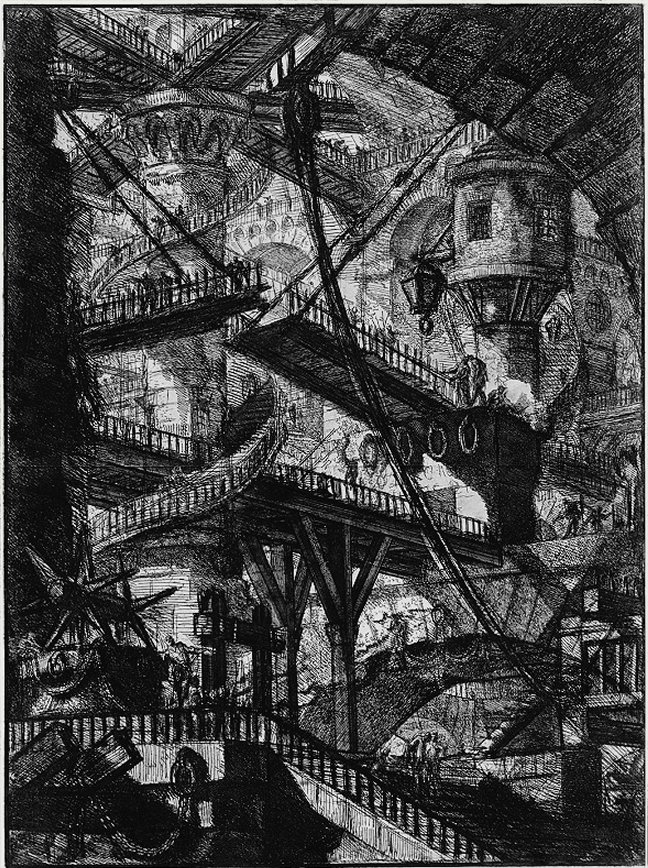
Reflected from his work, the Drawbridge - used as a way to get around the prison.
- Include a study room, and a library
His knowledge of various styles, engineering, ancient societies etc, may be all in the form of his books which would require a library for storage.
The study would be his own space to do all the types of work that he does - printmaking, etchings.
- Mural and furniture
Inspired, elaborate art on the walls around the home.
Same style/s for interior furnishing.
- Entrances
Large archways as entrances to different rooms/entrance to house
Sources
http://en.wikipedia.org/wiki/Giovanni_Battista_Piranesi
http://en.wikipedia.org/wiki/Matteo_Lucchesi
http://www.metmuseum.org/toah/hd/pira/hd_pira.htm
http://www.answers.com/topic/giovanni-battista-piranesi
- Bachelor pad
Piranesi had no partner or kids, so he will most likely be living alone.
- Grand, spacious, with a high ceiling for the rooms and overall look
Most of his work represent large ruins/buildings.
-Include stairs and/or drawbridge to travel around the home
Reflected from his work, the Drawbridge - used as a way to get around the prison.
- Include a study room, and a library
His knowledge of various styles, engineering, ancient societies etc, may be all in the form of his books which would require a library for storage.
The study would be his own space to do all the types of work that he does - printmaking, etchings.
- Mural and furniture
Inspired, elaborate art on the walls around the home.
Same style/s for interior furnishing.
- Entrances
Large archways as entrances to different rooms/entrance to house
Sources
http://en.wikipedia.org/wiki/Giovanni_Battista_Piranesi
http://en.wikipedia.org/wiki/Matteo_Lucchesi
http://www.metmuseum.org/toah/hd/pira/hd_pira.htm
http://www.answers.com/topic/giovanni-battista-piranesi
Sunday, 8 September 2013
Submission
PDF, SketchUp file and animation in the zip folder:
https://www.dropbox.com/s/yulho6c0wt847au/1390-3376470.zip
https://www.dropbox.com/s/yulho6c0wt847au/1390-3376470.zip
Friday, 30 August 2013

Wednesday, 28 August 2013
Week 4: 2D Representation (Piranesi)

I think the most problems I had with interpreting this artwork back its 3D form was the amount of ambiguity that was shown throughout. The depth of everything in the work was something that took a lot of my time to try and make sense of, once I thought that say, a bridge was where it was, it would contradict a tower or stairs.
I drew up the north elevation, plan, and east elevation respectively. The most thought provoking part was what I determined as the extended staircase which can be seen in the plan view and the east elevation. Whilst drawing these two views, I figured in order for my thought to work, the staircase had to be extremely long. Although it may be unrealistic, I believe it coincides with my interpretation and logic of the various movements throughout the prison.


Sources:


Subscribe to:
Posts (Atom)